



Which TV is Best:
LCD, Plasma, DLP, LCoS or LCD Rear Projection?
LCD Flat Panel Displays
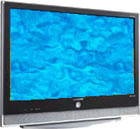
Flat panels could easily become the standard for all televisions in the future. The key stumbling block now is the high cost. LCD flat panels are the most expensive choice of all large screen televisions.
There are two technologies used for flat panel displays; LCD (liquid crystal) and gas plasma. They are currently the most expensive choices, but have at least one feature the others can't match; thickness. Flat panel displays are, on average, 4 inches thick. Both panels can be mounted on a wall or from the ceiling. Their size makes them ideal where space is at a premium or where they need to be hidden when not in use. Many flat panels have 42 inch screens (the smallest size available for plasma) although some 50 and 60 inch models are available. LCD also offers smaller screens, down to 15 inches.
LCD and plasma screens are both fixed pixel, flat panel displays. Because the pixels are fixed, incoming signals must be scaled to fit those pixels. Resolution for the most common Plasma screens are 1920 x 1080 for HD models and 1024 x 768 for 42" models and older models. LCD widescreen resolution typically is 1280 or 1366 x768. All plasmas are widescreen but some LCD's are still available in the 4:3 aspect ratio. Most panels display a progressive scan image, although some plasma panels use a technology called ALiS (Alternative Lighting of Surfaces) which results, in effect, in an interlaced image.
All units currently are sold with a built-in ATSC tuner, unless they are sold as monitor, in which case they have no channel tuner. Without an ATSC tuner, a separate tuner or set-top box will be required to receive television broadcasts. Some of the space saving value of flat panels is lost if you must have a separate tuner nearby.
Screen door effect is the term used to refer to the dark space between pixels on LCD displays. In some situations, it may give the impression of looking through a screen door at the image. This effect has been essentially eliminated in newer models.
Both plasma and LCD have difficulty rendering deep blacks, so the result is some inability to deliver image definition in dark sequences of programs or films.
| LCD Pluses: | LCD Minuses: |
|
|
 |
|
|
|
|
|
|
|
|
|
|
|
|
|
Section 1: DLP Rear Projection
Section 2: LCD Rear Projection
Section 3: LCoS Rear Projection


