




How To Unclog a Toilet
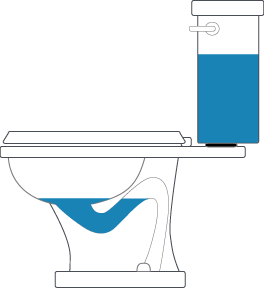
If water is threatening to overflow the bowl, you can lift off the tank lid and reach in and push the flapper down into the closed position. This will stop most of the flow of water into the bowl. However, some will still run down the sides of the bowl as the tank refills. You can stop this by pulling up on the float and closing the fill valve. You can also reach behind the toilet and turn off the valve that comes out of the wall or floor, to turn water supply to the toilet.
When water overflows the bowl it means there is something blocking the toilet or drain. There are a couple of clues to help you find whether the clog is local to the toilet, the bathroom or may be a housewide problem. In most cases, if the bathroom sink does not back up, then the blockage is in the toilet or very close to it. If the sink (or some other bathroom drain) is backing up, then the clog is farther along in the drain line. If drains elsewhere in the house are backing up, then the problem is likely to be somewhere in the sewer line. This article focuses on clearing those clogs that are in or near the toilet. Clogs farther along the drain or sewer lines will require different equipment and have to be accessed through a clean-out or by removing the toilet from the floor.
Caution: Please read our safety information before attempting any testing, maintenance or repairs.
If the clog might be an object dropped into the toilet, such as a toy or a washcloth, then it is best to try and retrieve it rather than force it threw the pipes. Other clogs resulting from normal flushed waste can be cleared with the use of a toilet plunger or closet auger.
Start With a Plunger to Unclog a Toilet
We recommend a plunger with a flange, rather than the old fashioned cup style. The flange fits into the opening at the bottom of the bowl and exerts more pressure than the old style plunger.
- If the bowl is full, put on some gloves and bail out water until the bowl is only half full.
- If the bowl is empty, add water to fill it to half full.
- In order to avoid the possibility of splash back, drape a large towel over the bowl and under the toilet seat.
- Place the plunger in the bowl and completely cover the drain opening.
- With the plunger completely under water, press and pull it rapidly for 15-20 seconds.
- If the water drains out of the bowl, add some more water and plunge again.
- If the water seems to be properly draining, go ahead and try flushing the toilet.
Next, Try a Closet Auger
If the water still is not draining out of the bowl as it should, then use a closet auger. A closet auger is a drain clearing tool designed specifically for use with a toilet. Typically it has a sharp spiral of wire on the tip and a semi-rigid wire that can flex through the bends in the toilet bowl. It also has a guide tube and an offset hand crank, to turn the spiral tip and clear the obstruction. Do not use other types of drain snakes with a toilet as they can damage the toilet.
- Insert the guide tube with the curve facing the direction of the drain. Some bowls drain to the front and some drain to the rear.
- Crank the auger in one direction until is becomes tight then crank in the other direction. Repeat this until the auger is in as far as it will go.
- Crank the auger to clear the obstruction.
- Pull the guide tube out of the toilet. If it gets stuck push and pull gently or turn a crank back and forth while gently pulling up. Do not force the auger or you may break the toilet bowl.
- Repeat the process using the plunger.
- If the water seems to be properly draining, go ahead and try flushing the toilet.


