





How To Use a Meter to Test Continuity
A continuity test is done to determine whether a circuit is open or closed. For example, a wall switch is closed when it is turned to the "on" position and it is open when it is turned off. An open circuit cannot conduct electricity. A closed circuit has continuity.
Caution: Please read our safety information before attempting any testing or repairs.
 This test should be done when current is NOT present. Always unplug the device or turn off the main circuit breaker before attempting a continuity test. Always test your test equipment for proper operation before use.
To test the continuity of a circuit requires the use of a multimeter (also called a multitester) or a continuity tester (a simple device that lights up to indicate continuity).
Set the multimeter to the ohm setting. The symbol for ohm is  , the Greek letter omega. If there is more than one ohm setting, choose X1. An analog meter, like the one pictured below, uses a needle to indicate the measured value. A digital meter performs the same test functions as an analog meter, with the key difference being that a digital meter provides a numeric reading instead of using a needle.
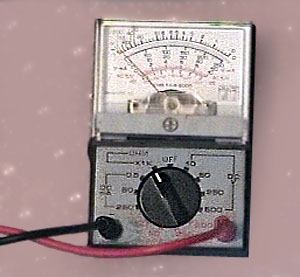
Note that while the probes are not touching anything, the multimeter will indicate a reading of infinity. A reading of infinity means that the circuit is open. When you touch the two probes together, the reading changes to zero. A reading of zero indicates that the circuit is closed or complete. A complete circuit is one that can conduct electricity; an open circuit cannot.
page 1 of 2


