




How to Test the Heating ElementThe heating element is used to heat the water and/or dry the dishes. If it does not function properly it can result in unsatisfactory cleansing of the dishes or the failure of a cycle to complete properly. Caution: Please read our safety information before attempting any testing or repairs.
First, open the door and look into the tub and locate the heating element (if it is covered, remove the lower dish rack and cover). The heating element has two terminals which extend through the bottom of the tub, note the general location where they go through. To access the heating element's wiring, remove the lower panel located beneath the door. The panel is usually held in place with two screws either above or below the panel. It may be necessary to first open the door to the dishwasher to reach the screws over the panel, then close the door to remove the panel. Look into the lower access area and locate where the terminals come through the tub. Each terminal has a wire connected to it. Label the wires and the terminals so that they can be properly reconnected. Pull the wire off of each terminal; they are connected with a slip on connector. Firmly pull the connector, do not pull on the wire. You may need to use a pair of needle-nose pliers. Inspect the connector and terminal for corrosion. If either is corroded they should be cleaned or replaced.
Test the resistance of the heating element using a multitester. Set the multitester to the ohms setting X1 and touch one probe to each of the terminals. A normal reading will be somewhere between infinity and zero. The exact reading differs by manufacturer and model. If the indicator does not move (infinite resistance) or moves to the other extreme of the scale (zero resistance) then the element is damaged and should be replaced. 
|
 Before testing the heating element, unplug the dishwasher or shut off the power at the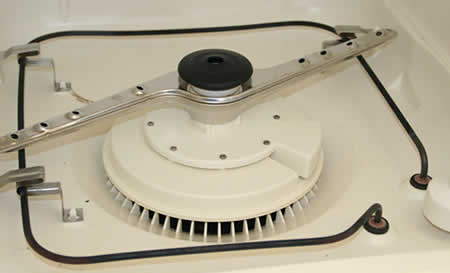
 |
|
