




How To Unclog a Bathroom Sink Drain
In the bottom of the bowl of a bathroom sink there is a drain and near the high water mark, there is an overflow drain, both connect to the same drainpipe under the sink. In the primary drain in the sink is a strainer which stops large objects from going down the drain. However, small objects and especially hair get into the drain. The strainer tends to snag hair and is often the cause of a slow or gurgling drain. Taking out the strainer and removing the accumulation of hair will resolve many slow or clogged drains. In some sinks the strainer simply lifts out or lifts out with a twist. On other sinks the strainer is held in place by the pivot rod, under the sink. Reach under the sink, find the long rod that connects to the strainer and remove it. Lift out the strainer and clean off the hair and soap build-up.
While we rarely endorse a product, we have found one to be indispensable, the Zip-It! It is a long plastic strip with barbs projecting off from the sides. You slip the Zip-It into the drain as far as it will reach, twist it a few times and pull it out. It will snag the hair in the drain and pull it right out. While you have the strainer out, or if cleaning the strainer didn't solve the problem, this is the time to try a Zip-It. The manufacturer calls the product disposable, but we have had the same in our toolbox for years.
Now if you still have a clogged sink, you might be thinking of using chemicals - Don't. Some chemicals can damage pipes, the environment or you if you get splashed. If you have to work on a drain after a chemical has been added, it makes the work harder and more hazardous. Additionally, most chemical drain cleaners don't work that well. Running hot water through clear drains is the best way to keep them clear. Skip the chemicals.
You can use a plunger, an auger or a blow bag to grind or push out a stubborn clog. We like the effectiveness of blow bags, but lets start with the old-standby, the plunger. For a sink, use a standard model without a flange, like the one below.
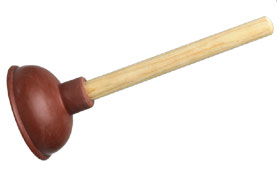
When plunging, there must be some water in the fixture, so add water if necessary. Tilt the plunger cup to burp the air as it is submerged in the water. Place the plunger over the drain and completely cover the drain opening. Sinks have an overflow drain. The overflow must be securely covered or the plunger will force the water out that way instead of down the drain. Seal the overflow drain opening with a towel. With the plunger completely under water, press and pull it rapidly for 15-20 seconds. If the water drains out of the fixture, add some more water and plunge again. If the water seems to be properly draining, go ahead and run some water to test the drain.
An drain auger, a smaller version of a drain snake, can be inserted down the sink drain or you can remove the P-trap fitting beneath the sink and insert it there. The advantage is that if you are driving the auger deep into the drain line, there will be less friction than if it has to weave its way through the trap before reaching the drain line. To remove the P-trap, simply unscrew the two collars at either end of the "U" shaped pipe. Insert the drain snake as far as you can, then turn the set screw tight to hold the auger cable and crank the handle (or use a power drill on some models). As you crank the handle the auger tip grinds at the clog. Continue to insert to auger cable as far as it will go. If the auger gets stuck, reverse the direction of cranking and pull gently on the cable to extract a short length. Then resume forward action.
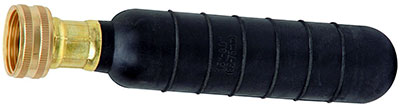
The last method, our favorite because it has worked so well for us in the past, is the blow bag. Imagine a heavy duty balloon that screws onto the end of a hose. Picture a balloon with small holes on the opposite end and whole thing is narrow enough to fit into a pipe. Slide the blow bag as far as you can, into the pipe under the sink and turn on the hose. The first thing the bag does is inflate with water until it is securely wedged in the pipe. Now water starts spurting out the other end to blast away at the clog. Leave it on for a while and the force of the water will push the clog all the way out to the main sewer line. To remove it, turn off the water, wait a few seconds for it to deflate and then gently pull it out from the drain. Reconnect the section of pipe removed earlier and you should have a clear running drain.


