




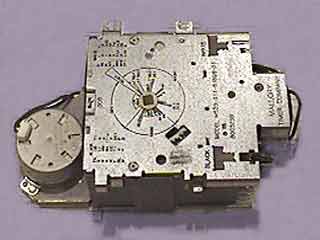
How To Test the Timer Motorcontinued from page 2 Locate the timer motor. If you find two motors, the second is the rapid advance motor which operates when the wash cycle is canceled or reset. If you cannot determine which motor is the timer motor, test them both.
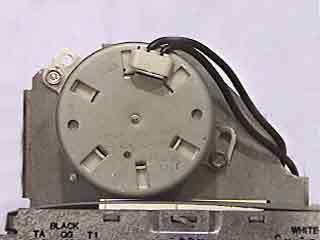
The round motor housing has two wires extending from it. Follow the wires to the terminal connections. Label the wires and connections so that you can properly reconnect them later. The wires are connected with slip on connectors. Firmly pull the connectors off of the terminals (do not pull on the wire itself). You may need to use a pair of needle-nose pliers to remove the connectors. Inspect the connectors and the terminals for corrosion. If either is corroded they should be cleaned or replaced.
Use a continuity tester or multitester to test for continuity. Set the multitester to the ohms setting X1000. Touch one probe to each wire. A reading in the range of 2,000 to 3,500 ohms is normal for most dishwashers. If a schematic of your dishwasher can be located, it should indicate the proper resistance for your timer motor. The schematic may be in one of the service areas of your dishwasher or your owner's manual. If your measurement varies substantially from normal range, the timer should be replaced. page 3 of 3 
|
 |
|
